
If your mortgage is coming up for renewal, your new payment comes from four numbers: your remaining mortgage balance, the new mortgage rate, the years left on your amortization and your payment frequency. Your lender's renewal statement gives you the first two. Put all four into a mortgage renewal calculator, or use the table below, and you'll know your new monthly payment before you sign anything. Here's how to calculate your mortgage renewal payment, and what moves it.
Start with your current mortgage lender. Its renewal offer is a first offer, and you can negotiate it. If the rate is competitive, renew there. You don't need a mortgage broker for that. The easiest path isn't automatically the best one, so compare before you sign.
How to calculate your mortgage renewal payment
You need four numbers. Here's where to find each one.
- Your remaining mortgage balance. If your mortgage is with a bank or another federally regulated lender, it must send you a renewal statement at least 21 days before your term ends. The Financial Consumer Agency of Canada says that statement must show the balance at the renewal date, the interest rate, the payment frequency, the term and any fees.
- The new rate. Use the rate in the statement first, then the current rates other lenders quote you.
- Your remaining amortization period. Take the amortization on your original mortgage and subtract the years you've paid. A 25-year mortgage after one five-year mortgage term has 20 years left.
- Your payment frequency. Monthly, biweekly or weekly. On a regular payment schedule, a biweekly or weekly payment splits the year's monthly payments evenly. An accelerated payment adds the equivalent of one extra monthly payment a year, the consumer agency says, which pays the mortgage down faster.
The math is the standard mortgage payment formula: the mortgage amount you still owe, the rate per payment period and the number of payments left. A mortgage calculator does it for you, and our renewal calculator uses your home's value and what you owe. Your lender's payment amount can differ by a few dollars, because the Interest Act lets a mortgage contract state its rate "calculated yearly or half-yearly", and the choice changes the result slightly.
Mortgage payment calculator table: monthly payment per $100,000
Find your new rate and the years left. Multiply the figure by your balance in hundreds of thousands. If you owe $350,000, multiply by 3.5.
- 2.50%: $529 a month with 20 years left, $448 with 25 years left.
- 3.50%: $579 a month with 20 years left, $499 with 25 years left.
- 4.00%: $604 a month with 20 years left, $526 with 25 years left.
- 4.50%: $630 a month with 20 years left, $553 with 25 years left.
- 5.00%: $657 a month with 20 years left, $582 with 25 years left.
- 5.50%: $684 a month with 20 years left, $610 with 25 years left.
These monthly mortgage payments are principal and interest only, with interest calculated half-yearly. Property tax and insurance aren't included.
How much will my mortgage go up at renewal?
It depends on the rate you're leaving. In its May 2026 Financial Stability Report, the Bank of Canada said the last of the five-year, fixed-payment mortgages taken out during the pandemic would renew over the following 12 months. That group is about 12% of all outstanding mortgages in Canada, and those borrowers would see their payments rise by about 15% on average. The Bank's figures used rate expectations from May 2026, before its October hike.
A fixed mortgage rate follows bond yields
Bank of Canada Senior Deputy Governor Carolyn Rogers said in 2024 that Canadian fixed-rate mortgages are generally benchmarked off five-year government bond yields. The five-year Government of Canada bond yield was 1.45% on 12 November 2021 and 3.53% on 12 November 2026, according to the Bank of Canada. That's why a fixed mortgage taken in 2021 usually renews higher. The Bank's Financial Stability Report says borrowers who took out a mortgage at very low interest rates during the pandemic have been renewing at higher rates.
Variable mortgage rates follow prime
The Bank of Canada raised its policy rate to 2.50% on 28 October 2026, and prime at the major banks rose to 4.70% the next day. Each lender sets its own prime. The next rate decision is on 9 December 2026. We don't predict it, and nobody can promise you where rates will be at your renewal date.
What changes your mortgage payment at renewal
The end of a term is the time to review your mortgage needs, the consumer agency says. The rate is the biggest lever. These are the others.
- The amortization. Stretching it lowers the payment and raises the interest you'll pay. The consumer agency says to think twice before extending your amortization, because the extra interest can add up to thousands or tens of thousands of dollars. Adding years with your own lender isn't a refinance, but it only works if your lender registered a collateral charge when you closed, meaning a charge for more than you borrowed. Ask your lender which kind you have before you count on it.
- A lump sum. At the end of your term you can put a lump sum down without a penalty to lower your mortgage balance, and with it your payment.
- The term. A shorter or longer mortgage term changes the rate you're offered.
- The lender. You don't have to renew with your current lender. Shop a few months before your term ends.
Renew with your mortgage lender, switch or refinance
Staying with your current lender doesn't mean qualifying again or passing the stress test.
Switching is different. The new lender has to approve your mortgage application and may use different criteria, according to the consumer agency. Expect to provide current income documents. If you move an uninsured mortgage to another federally regulated lender with no increase to the amount or the amortization, the Office of the Superintendent of Financial Institutions doesn't expect that lender to apply the stress test. Insured mortgages were already exempt. If your mortgage has mortgage default insurance, keep the same amount and amortization when you switch, or you may pay a new premium.
Borrowing more is a refinance. Adding years can be too, and at a new lender it ends the straight-switch exemption. At a bank or another federally regulated lender, a refinance means the stress test: you qualify at the greater of your contract rate plus 2% or 5.25%. Credit unions follow FSRA's own lending guidance, and private lenders set their own rules. Some of them use a stress test too.
What switching costs and how a mortgage broker is paid
Switching at the end of your current mortgage term carries no prepayment penalty, since the penalty applies when you move before the term ends. There are still costs if you move: discharge, registration, transfer or assignment fees, sometimes an appraisal and other administration fees. Ask the new lender which ones it will pay, and get the answer in writing.
A broker may be paid by the lender rather than by you. Under Ontario's brokerage rules, a brokerage has to tell you in writing whether it gets paid by anyone else on a mortgage or renewal it presents to you, who pays it and how the amount is worked out. Ask any broker, including us, for that disclosure before you choose.
Should you renew your mortgage early?
Some lenders let you renew early with a blend-and-extend: your old rate and the new term's rate are blended. Breaking your mortgage early is another matter. On a fixed rate, the prepayment penalty is usually the higher of three months' interest or the interest rate differential, and it can cost thousands of dollars. Ask for the penalty in dollars. If it's bigger than the interest you'd save, wait for your renewal date.
When you shouldn't stretch your renewal
A lower payment is sometimes the wrong goal, regardless of what that does for our business. If you're extending your amortization or adding money to your mortgage to cover a monthly shortfall, the shortfall is still there next year. It now sits on your home, for longer, with more interest. Sort out the budget first. Then pick the mortgage.
Case study
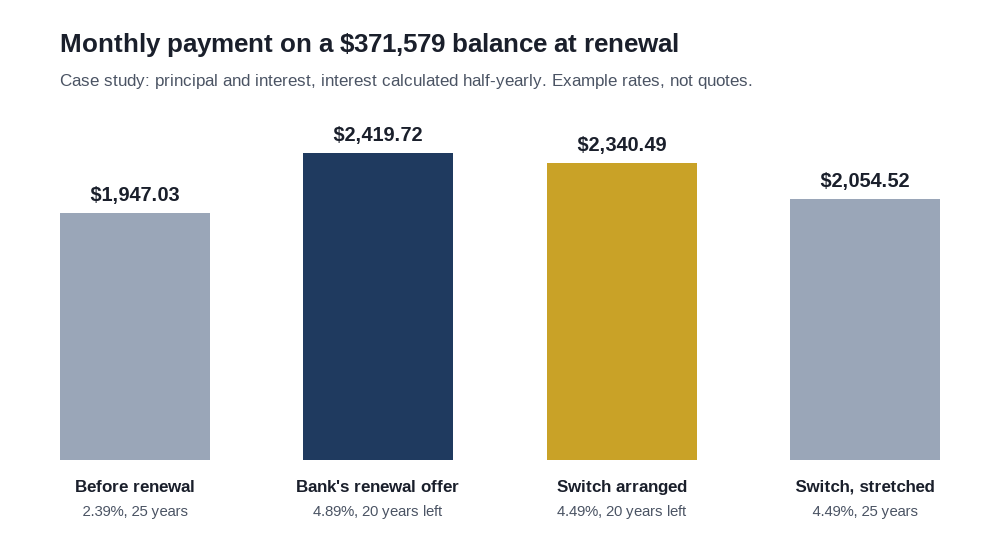
Ines and Walter owned a home in Pickering valued at $670,000 with a $371,579 mortgage balance at renewal, left from a $440,000 five-year fixed they took in October 2021 at 2.39% over 25 years, at $1,947.03 a month. Their bank's renewal offer was 4.89% for five years over the 20 years left, a monthly payment of $2,419.72, or $472.69 more. We arranged a straight switch of their uninsured mortgage to another federally regulated lender at 4.49%, with the same balance and the same 20 years, a payment of $2,340.49, and the new lender agreed to pay the switching costs. They gave it current income documents, and it checked their file at the contract rate, without the stress-test add-on. They still pay $393.46 a month more than before, but over the five-year term they'll pay about $6,968 less interest than under the bank's offer. They passed on a 25-year amortization at $2,054.52 a month: it would have added about $54,638 in interest over the life of the mortgage, and the longer amortization would have taken the move outside the straight-switch exemption. These rates are examples to show the math, not quotes.
Should you stay, negotiate or switch?
- Your lender's offer matches the best rate you can find. Renew with your current lender. There's no new application and no switching costs.
- Another lender quotes a lower rate. Take that offer back to your lender, then decide. You may qualify for a lower rate than the renewal letter quotes, and the consumer agency says to tell your lender about other offers.
- The new payment doesn't fit your budget. Talk to someone before you extend the amortization or borrow more. A longer amortization costs more interest, and more money is a refinance, which a bank will stress test.
Frequently asked questions
How many months before my mortgage renewal should I start?
A few months before your term ends. The consumer agency says to start shopping then and not to wait for the renewal letter. A bank only has to send the statement 21 days before the term ends.
Can I pay off my mortgage at renewal?
Yes. At the end of a term you can pay off your mortgage in full or renew it. The consumer agency says the end of the term is also when you can make a lump-sum prepayment without a penalty.
What is the formula to calculate mortgage payments at renewal?
Payment = balance × periodic rate ÷ (1 − (1 + periodic rate) to the power of −number of payments). Use your remaining balance, the new rate and the payments left on your amortization. For a fixed rate calculated half-yearly, the monthly periodic rate is (1 + rate ÷ 2) to the power of 1/6, minus 1. A $100,000 balance at 4.50% with 20 years left comes to $630 a month.
Will my lender stress test me when I renew?
Not if you stay. Switching an uninsured mortgage to another federally regulated lender for the same amount and amortization doesn't need the stress test either, but you'll still provide income documents. Borrowing more at a bank does.
Use a mortgage renewal calculator, then compare
Run your numbers on our calculator to see your estimated monthly mortgage payment. Then ask your own lender for its best rate. If it matches the market, renew and you're done, without us. If your file falls outside its criteria, or you want to see what the rest of the market offers, talk to a broker. We'll put your mortgage renewal offer next to the mortgage options other lenders have, show the fees and your new mortgage payment in writing, and tell you when staying put is the better answer.

Lighthouse Lending Inc., licensed mortgage brokerage, FSRA #13301. This guide is for general information only and is current as of November 2026. Rates, limits, and figures shown are illustrative, vary by lender and by your situation, and are subject to change. This is not an offer of credit, financial advice, or a commitment to lend. Speak with a licensed mortgage professional about your own circumstances.