
A bank "no" isn't the end of the road, and it says more about the bank's rulebook than about you. If a bank denied your debt consolidation loan and you own a home with equity, that answer usually comes from the bank's credit and income rules, and it doesn't mean the equity route is closed. If you haven't asked your bank about consolidating through your mortgage, start there, because it already has your file and payment history, but its criteria are strict and the easiest path isn't automatically the best, so compare. When your file falls outside those criteria, a broker can show you a suite of solutions the bank can't extend.
Key points if you weren't approved for a debt consolidation loan
- A bank may deny a debt consolidation loan because of your credit report, your income against your payments or the federal stress test, even when you have plenty of equity.
- At a federally regulated bank, borrowing against your home tops out at 80% of its value under the federal Bank Act, and the revolving line-of-credit part at 65% under OSFI Guideline B-20. Outside the banks, Ontario credit unions work under FSRA's lending guidance, while mortgage investment corporations and private lenders set their own limits. We keep combined borrowing, including any second mortgage, at 80% or less of your home's value with every lender, so you keep at least 20% equity.
- A second mortgage from an alternative or private lender usually costs more than a bank loan, often comes with lender and broker fees and is meant to be a short-term bridge with an exit plan.
- Last checked November 2026 against the Financial Consumer Agency of Canada (FCAC), FSRA, OSFI and the federal Bank Act.
Common reasons a debt consolidation loan may be denied: credit score, income and the stress test
Banks look at more than equity. The FCAC says a lender checks your credit report and credit history, your income and everything you already owe. Its guidance is that housing costs shouldn't pass 39% of gross income (the gross debt service ratio, or GDS) and housing plus all other payments shouldn't pass 44% (the total debt service ratio) (FCAC).
Then there's the stress test. Banks must qualify you at the higher of 5.25% or your negotiated rate plus 2%, and that applies when you refinance or take out a home equity line of credit. Lenders that aren't federally regulated set their own qualifying rules, and some ask for a stress test too. A few missed payments, a job change or a high credit card balance can push you past one of these lines while your house value sits untouched. If the balances are small, the FCAC also lists a credit card balance transfer as a way to consolidate, with a promotional rate that usually lasts 6 to 18 months.
Turned down for a consolidation loan? Here's what a second mortgage lender can do.
A second mortgage is a separate loan registered behind your first mortgage. You keep paying the first mortgage and add a second payment. The rate is higher than on a first mortgage, because the lender behind the first one is taking more risk.
The 65% line-of-credit limit is an OSFI B-20 expectation for federally regulated lenders, which means the banks (OSFI B-20), and the 80% limit on a bank's mortgage lending comes from the federal Bank Act. Credit unions follow FSRA's own guidance, and mortgage investment corporations and private lenders set their own limits. Private lenders usually lend on the value of the property rather than your income. It doesn't have to be a loan, either: equity lenders do give home equity lines of credit to homeowners with bruised credit, which suits someone with a few years left on their first mortgage. Whichever lender it is, we keep combined borrowing, including the second mortgage, at 80% or less of your home's value.
FSRA says only a Level 2 mortgage agent or a mortgage broker can arrange a loan from alternative or private lenders, and describes these mortgages as a temporary option for one or two years, with a realistic exit strategy. Private mortgages are typically a fixed rate for a short term, commonly one year, and many are interest only, which keeps the payment low and doesn't reduce what you owe. If you need more time when the term ends, a renewal carries a renewal fee.
What a second mortgage for debt consolidation actually costs
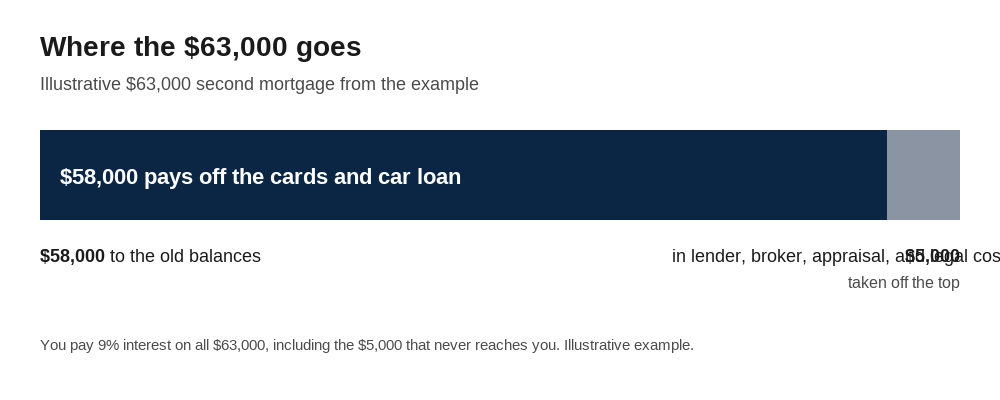
Borrowing against your home comes with an appraisal, a title search, title insurance and legal fees. Alternative and private lenders often add a lender fee, and the broker may charge a broker fee, usually 1% to 2% on a private second. Both usually come off the top, so less lands in your account than the approval says. A lower interest rate only helps if the fees and the term don't eat the saving.
FSRA's own example of a homeowner the bank declined for a consolidation shows a one-year interest-only private mortgage at 9%, with $20,325 in fees added to the loan (FSRA). Your numbers will differ. The rule doesn't: Ontario brokerages must disclose their fees in writing and include them in the cost of borrowing and the annual percentage rate. On a mortgage of $400,000 or less, a brokerage can't ask you for an upfront payment or deposit (FSRA).
On a bank deal the lender pays the broker, not you. Where there is a broker fee, it moves with how complex your file is, the exit strategy and the plan for the renewal, so judge a broker on more than the fee. Pick one on price alone and you tend to pay for it at renewal. FSRA expects a broker to recommend what suits the borrower, not the lender paying the higher commission, and to disclose it when a suitable product pays more. Ask any broker, including us, why they chose that lender. If anyone won't put the fees in writing, walk away.
Case study
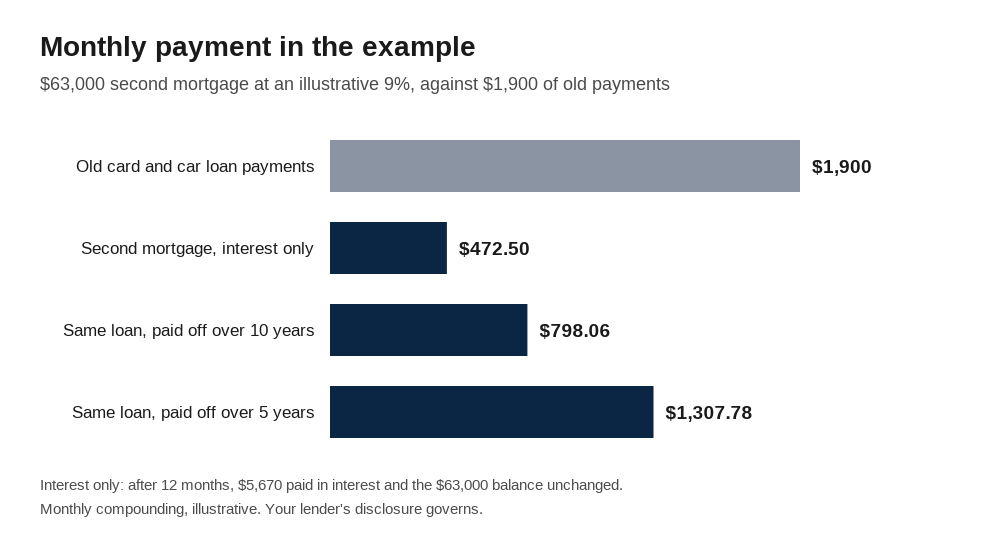
Nina and Chris (an example, not actual clients) own a home in Peterborough valued at $655,000 with a $400,000 mortgage that comes up for renewal in about a year. After a job change and missed card payments, their bank denied a debt consolidation loan, leaving $58,000 of card and car-loan balances costing about $1,900 a month.
In this example, their broker arranges a $63,000 interest-only second mortgage for a one-year term at an illustrative fixed 9% (FSRA's example used 9% on a private first mortgage; second mortgages usually cost more), with $5,000 of it covering lender, broker, appraisal and legal costs, bringing their two mortgages to $463,000, about 71% of the home's value. The payment is $472.50 a month, against $798.06 if the loan were paid off over 10 years or $1,307.78 over 5 (calculated with monthly compounding, and your lender's disclosure governs). Because it's interest only, year one costs $10,670 ($5,000 in costs plus $5,670 in interest), and they still owe $63,000.
The exit is a bank refinance when both terms end together: their $463,000 fits under a bank's 80% ceiling as long as the home appraises at $578,750 or more, about 12% below today's $655,000. That only works if their credit report and current income documents now pass the bank's ratios and stress test. If they don't, renewing the second mortgage for another year at 9% costs another $5,670 in interest plus a renewal fee.
When borrowing against your home is the wrong move
There are homeowners for whom borrowing more against the house is the wrong move, regardless of what that does for our business. If your income can't cover even an interest-only second payment on top of the first mortgage, a second mortgage converts a cash flow problem into a larger loan secured by your home. If money runs short again, your home is on the line.
It's also the wrong move when you have no believable exit plan or when the habits behind the balances haven't changed. Keep the spending habits and the balances come back. In those cases we'll tell you not to borrow, even if a lender would say yes.
What this guide can't tell you
It can't quote your second mortgage rate or fees, because those depend on your file. Get every number in writing, and if you're weighing two offers, put them side by side on one page.
Which debt consolidation options fit a homeowner the bank declined?
| Your situation | What to do | The number to check |
|---|---|---|
| Your bank will approve a consolidation | Take the offer in writing and compare it with one other quote | The total cost over the term, fees included |
| Steady income, equity, credit bruised by a short rough patch | Price a second mortgage for debt consolidation, with an exit plan | Both mortgages under 80% of value at renewal: $463,000 needs a $578,750 appraisal |
| Income can't carry an extra secured payment | Don't add a loan against your home | Total payments above 44% of gross income even with an interest-only second |
| Balances manageable without new borrowing | Keep paying them down from your current cash flow | Balances clear with no new loan |
Frequently asked questions
Can a homeowner get help with debt consolidation after a bank says no?
Often, yes. Lenders outside the banks, such as credit unions, mortgage investment corporations and private lenders, work under different rules from the banks. Private lenders often lend on the property's value, at a higher rate, with fees and a short term. With every lender, we keep combined borrowing at 80% or less of your home's value.
Should I apply to several banks after a debt consolidation loan is denied?
No. The FCAC says several applications in a short time may lower your credit score. Find out why the first bank said no, whether credit history, income or the stress test, then apply once with a lender where your file fits.
Will a second mortgage hurt my credit score?
The FCAC says consolidation may help your score if you pay on time and cut the number of high-balance accounts. A new lender will see the second mortgage on your title when you refinance or switch, so plan how you'll pay it out.
What happens if I fall behind on a second mortgage?
Your home is the security, and the FCAC warns that missed payments can bring serious consequences, like the foreclosure of your home. FSRA tells borrowers to check, before signing, whether the contract adds interest or fees for late or missed payments and whether the power of sale process starts very quickly. Ask for those answers in writing.
Start with your bank, then compare
Ask your bank first. If it approves a debt consolidation loan, get the offer in writing and compare it with one other quote before you sign. The easiest path isn't automatically the best. If your bank denied the consolidation loan and you're an Ontario homeowner with equity, talk to a broker who can reach the lenders the bank can't. We'll show you exactly what consolidating through your home equity costs, in dollars, with every fee in writing, and if borrowing against your home isn't the right move for you, we'll tell you that instead. No impact on your credit to ask.

Lighthouse Lending Inc., licensed mortgage brokerage, FSRA #13301. This guide is for general information only and is current as of November 2026. Rates, limits, and figures shown are illustrative, vary by lender and by your situation, and are subject to change. This is not an offer of credit, financial advice, or a commitment to lend. Speak with a licensed mortgage professional about your own circumstances.