To stop foreclosure in Oshawa, you first need to know which process you're in. If the letter is a notice of sale, the lender is using a power of sale, and Ontario's Mortgages Act gives you at least 35 days from the date it was given before the lender can sell. Inside that window you can pay the arrears and costs, replace the mortgage or sell the home yourself.
Start with the lender that sent the letter. Its arrears department has your file, section 22 of the Act lets you demand, in writing, the exact amount you're behind plus the lender's expenses, and a bank is expected to offer relief options to a homeowner at risk of default on a principal residence. That's the easiest path. It isn't automatically the best one, and when your situation falls outside the bank's criteria, a broker can show you options the bank can't extend.
Key takeaways
- Under section 32 of Ontario's Mortgages Act, a lender can't give a notice of sale until a payment has been in default for at least 15 days, and can't sell for at least 35 days after the notice is given.
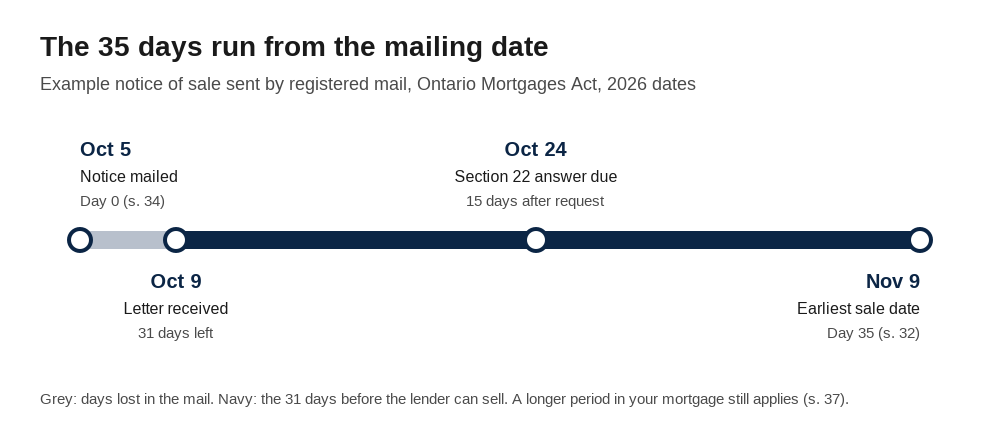
- A notice of sale sent by registered mail counts as given on the day it was mailed (section 34), so a letter that arrives four days after mailing leaves you about 31 days, not 35.
- Section 22 of the Mortgages Act lets a homeowner cure the default before the sale, as long as the mortgage term hasn't ended, by paying the amount in default plus the lender's necessary expenses, and the lender must answer a written request for that figure within 15 days. In practice you have until there's a firm sale, and you can sell the home yourself up to that point. Once you've been evicted it's usually too late, so the planning starts at the first missed payment, not when a buyer appears. Where that line falls in your case depends on the stage of the sale, so ask a real estate lawyer right away.
Power of sale vs foreclosure in Ontario: which one is happening?
Homeowners facing a power of sale often search "foreclosure," but Ontario law treats them as two different processes, and power of sale is the one you'll almost always be in.
A foreclosure in Ontario is a court action. Under Rule 64 of Ontario's Rules of Civil Procedure, the foreclosure process starts with a statement of claim, and if it runs to the end, the lender ends up owning the property and everything the sale brings in, including any amount above what you owed. That's a hard order for a lender to get, which is why foreclosure is rare and why most Ontario homeowners are in a power of sale instead.
A power of sale is different. When your mortgage contains a power of sale clause, the lender may sell the property without a court order, as long as it follows the notice rules in Part III of the Act. For sales under the statutory power, section 27 sets the order the sale proceeds are paid: sale costs, interest and costs, principal, later mortgages, tenants' rent deposits and the rest to the owner.
The practical test is the paper in your hand. A notice of sale under mortgage means the power of sale process has started. A statement of claim means a court action. The rest of this article covers power of sale proceedings.
How the power of sale in Ontario counts your 35 days
The rules are the same for Ontario homeowners in Oshawa, Whitby or Ajax. What trips people up is the counting.
| Step | What the Mortgages Act says | Section |
|---|---|---|
| Default | No notice until a payment has been in default for at least 15 days | 32 |
| Notice given | In person, by registered mail or left at your address. Registered mail counts as given on the day it's mailed | 33, 34 |
| Waiting period | No sale for at least 35 days after the notice is given | 32 |
| Longer terms | If your mortgage gives you a longer period, the longer period applies | 37 |
| During the waiting period | No further proceedings or court action to enforce the mortgage until that period passes, unless a judge allows it | 42 |
| Before the sale | You can cure the default by paying the arrears plus necessary expenses | 22 |
Here's the counting trap with dates. Say the letter was mailed on Monday, 5 October 2026, and reached your mailbox on Friday, 9 October. The 35 days run from 5 October. Under section 89(3) of Ontario's Legislation Act, 2006, the mailing day is excluded and day 35 counts, so 9 November is the first day the lender can complete the sale. From the day you opened the envelope, you had 31 days. Hand the lender a written section 22 request that Friday and its answer is due within 15 days, by 24 October, still 16 days before the earliest sale date.
Two more rules matter inside that window.
- Ask for the number in writing. If the lender, without a reasonable excuse, doesn't answer your section 22 request within 15 days, or the answer is incomplete or wrong, its enforcement rights are suspended until it complies.
- The lender can ask a court to skip notice. Section 39 lets a lender apply to a judge for leave to sell without notice. If a court document arrives, call a lawyer the same day.
Options to stop foreclosure in Oshawa and Durham Region
There are four ways to stop the process.
Reinstate with your current lender
If the missed payments are behind you, reinstating is the cheapest fix. You pay the arrears plus the lender's legal costs, the mortgage goes back into good standing and nobody new is involved. Section 22 makes this a right before the sale, not a favour. This doesn't work once your mortgage term has ended: at maturity the whole balance is due, so you'd need to pay it out or arrange a renewal.
If your mortgage is with a bank, also ask about relief measures. The Financial Consumer Agency of Canada (FCAC) expects banks to offer tailored support to homeowners at risk of default on their principal residence. That can mean waived fees for a limited period or a longer amortization, which FCAC warns can add tens of thousands of dollars to the total cost. Provincially regulated credit unions and private lenders are outside these expectations.
The trade-off is plain. Reinstating only works if the income problem is solved. Otherwise the same letter comes back.
Refinance when the home still qualifies
A refinance replaces the mortgage with a larger one that covers the arrears and costs. At a federally regulated bank, the federal Bank Act caps a conventional mortgage at 80% of the home's value, and that's the ceiling a bank refinance works within. OSFI's B-20 guideline also expects banks to cap non-conforming loans at 65%, and its list of non-conforming loans includes loans to borrowers with low credit scores. If missed payments have lowered your credit score, your file may fall into that group, so ask the bank where it sits. Any refinance needs current income documents, at your own bank too.
Outside the banks, Ontario credit unions follow FSRA's own lending guidance, and mortgage investment corporations and private lenders set their own limits. We keep combined borrowing, including any second mortgage, at 80% or less of your home's value with every lender, so you keep at least 20% equity. A refinance or home equity loan from a mortgage investment corporation or private lender costs more, and is the route when the equity is there but the file no longer fits bank rules.
Use a private second mortgage as the reset
A second mortgage leaves your first mortgage in place and adds a smaller loan behind it. The money brings the first mortgage current and the power of sale stops. Private mortgages are typically a fixed rate for a short term, commonly one year, and usually interest only. On the maturity date you pay it out or renew it, and a renewal carries a renewal fee. CMHC's October 2021 Residential Mortgage Industry Report described alternative lenders as providing "shorter-term mortgages at higher fees and interest rates," and put rates at mortgage investment entities, one type of private lender, at 6.5% to 15% at that time. No regulator publishes a current range, so the only number that counts is the one in your written quote.
Sell the property yourself
Before the lender sells, you can sell the property yourself, keeping the sale price, the agent and the timing in your hands. The mortgage is paid out of your sale proceeds at closing. The point at which the lender's sale can no longer be stopped depends on its stage, so ask a real estate lawyer right away and have them line up your closing with the notice. If your mortgage is with a bank and you sell your principal residence while at risk of default, FCAC expects the bank to offer temporary relief such as waiving the prepayment penalty. Ask for that in writing.
Every homeowner facing foreclosure or power of sale has different numbers. Laying them out side by side is what our stop power of sale assessment is for.
What a private mortgage actually costs you
The interest rate is only part of the bill. On a private mortgage, expect a lender fee, legal fees for the new mortgage and the enforcement costs your current mortgage lender has already added. A mortgage broker arranging a private file may also charge a broker fee, so ask.
The Financial Services Regulatory Authority of Ontario (FSRA), which licenses mortgage brokerages, says in its suitability guidance that a brokerage should explain the cost of borrowing, prepayment and renewal costs, and "any additional costs paid to lenders, brokers or other parties." Hold every broker to that, including us: the lender fee, the broker fee, the legal fees and the amount that lands in your account, in writing, before you sign. Ask how the broker is paid on your file, and why they chose that lender, because the product that pays a broker best and the product that costs you least aren't always the same one. If a broker won't put the fees in writing, walk away from them.
Case study
Lorraine owns a townhouse in Oshawa valued at $610,000 with a $448,000 first mortgage at her bank (an example, not an actual client). Her bookkeeping business lost its two largest clients last year, her income has settled about a third lower, and the $2,570.72 monthly payment (an illustrative fixed 4.64% over the 24 years left) no longer fits. She has missed four payments, $10,283 in arrears, and her notice of sale follows the countdown above, with 31 days left. The notice alone typically adds about $5,000 in the lender's costs, before any administrative and legal fees on top, so she needs at least $15,283 to reinstate.
On paper the home has room: an 80% bank ceiling leaves $40,000 for a refinance, though with four missed payments a bank may treat the file as non-conforming at 65%, which leaves no room at all. And a refinance needs current income documents, and hers no longer support the payment. In this example, her broker prices the private route too. A one-year private second mortgage of $17,500 at a fixed 11%, interest only, would clear the $15,283, with the other $2,217 covering the lender fee, broker fee, appraisal and her lawyer. Combined borrowing, including the second mortgage, would be $465,500, about 76% of the home's value. It would stop this notice for $4,142 over the year ($1,925 in interest plus the $2,217 in costs), and add a $160.42 monthly payment on top of a first-mortgage payment she already can't make. On the maturity date she'd have to pay it out or renew it, and a renewal carries a renewal fee.
So she lists the home inside the window. If it sells for $610,000, she'd owe at least $459,863 plus interest to the closing date and the lender's administrative and legal fees: the $448,000 balance, about $6,863 of unpaid interest on the four missed payments and at least $5,000 of costs. That leaves at most about $150,137 before selling costs and any prepayment penalty, which she asks her bank in writing to waive. Her lawyer gets the payout figure from the lender in writing and lines up the closing with the notice.
When selling costs less than refinancing
There are situations where borrowing more is the wrong move, regardless of what that does for our business. The test is the monthly payment, not the arrears.
In the example, the second mortgage would stop this notice, but Lorraine's payment still wouldn't fit. If she fell behind again, each missed month would add about $1,716 of interest on the first mortgage and $160.42 on the second to what she owes, and a new notice would bring new legal costs. The $4,142 would buy time and fix nothing.
Selling is usually cheaper than refinancing when the household can't carry the first mortgage payment at any rate on offer, or when the only loan available has no believable plan to pay it out.
A sale you run inside the window isn't a failure. When the payment itself is the problem, it keeps the most equity.
Which option fits your situation?
| Your situation | What to do | Why |
|---|---|---|
| The missed payments are behind you and you can raise the overdue amount plus costs | Ask your lender in writing for the section 22 statement and reinstate | Cheapest fix, no new loan and the Act lets you cure before the sale |
| Your income is back but you can't raise the lump sum, and the home would keep at least 20% equity after borrowing | Price a refinance first, then a short private second mortgage, with every fee in writing | It stops the sale at a known cost, as long as you have a plan to pay it out |
| Your income can't carry the mortgage payment at any rate on offer | List and sell the home yourself inside the window | More borrowing delays the sale and spends equity; a sale you control keeps the most |
What this article can't tell you
This article reads the Mortgages Act as it stood in November 2026, and isn't legal advice. Your exact default date, how the notice was served and whether a court action has started all change the answer, and an Ontario real estate lawyer can confirm your dates.
Last checked November 2026 against the Mortgages Act on Ontario e-Laws, the federal Bank Act, OSFI Guideline B-20, FCAC and FSRA guidance and CMHC's 2021 industry report.
Frequently asked questions
Can I still stop the power of sale after the 35 days?
Possibly. Section 22 lets you cure the default at any time before the sale if your mortgage term hasn't ended, but once the window passes, the lender can move to sell at any time. Whether you still can depends on how far the sale has gone, and a real estate lawyer can tell you, so call one right away. If the lender has started a court action, section 23 sets out how to ask the court to dismiss or stay it.
Who else gets a copy of the notice of sale?
Section 31 of the Mortgages Act requires the notice to go to everyone the land registry record and the execution index show as having an interest in the property, other than interests ranking ahead of the mortgage being enforced. That includes later mortgage lenders and execution creditors, and the Crown or another public authority with a statutory lien the lender has written notice of. If you have a second mortgage or a registered lien, those parties will usually get a copy, and they may want to be part of the fix.
Will a private mortgage stop foreclosure in Pickering or Scarborough?
Yes, if the home has enough equity. Homeowners in Pickering and Scarborough have the same Mortgages Act rights as in Oshawa, so a private second mortgage that pays the arrears and costs stops the sale there too. We keep combined borrowing, including the second mortgage, at 80% or less of the home's value. It costs more than bank money, so treat it as a bridge with an exit plan.
Talk to a broker as soon as the notice arrives
Call your current lender's arrears department first and ask for the reinstatement number in writing. If you can pay it, do that, and you don't need us. If you can't, or your file falls outside what the bank can do, a broker earns their place by showing you what the bank can't extend. We'll lay out what it takes to stop foreclosure in Oshawa or anywhere in Durham Region, every fee in dollars. Whichever path fits, we can arrange it, or point you to the one we can't. If selling costs you less than borrowing, we'll tell you that instead.

Lighthouse Lending Inc., licensed mortgage brokerage, FSRA #13301. This guide is for general information only and is current as of November 2026. Rates, limits, and figures shown are illustrative, vary by lender and by your situation, and are subject to change. This is not an offer of credit, financial advice, or a commitment to lend. Speak with a licensed mortgage professional about your own circumstances.